AI chatbots on Telegram: when they pay off and when they annoy
Roughly one in three clients who come to us for a bot asks for one “with ChatGPT, so it answers everything by itself”. Sometimes that's the right call. More often it isn't. Here's where the line is, using bots we've built.
 Mirodil OrtiqovBackend developer
In the spring, the owner of a small shop messaged me. He wanted a bot that "talks like a real salesperson": the customer writes anything, the bot understands, suggests a product, takes the order. I asked how many orders a day he was getting through Instagram. About fifteen, it turned out, and nearly all of them sounded the same: "how much is it", "can you deliver tomorrow", "can I pay with Payme".
Fifteen orders like that don't need a neural network. They need five buttons.
I've been writing bots on aiogram for several years, and over the past year "can we add AI?" has come up on almost every call. This is how I answer it now.
Buttons versus free text
A classic bot walks a person through a script: catalogue, cart, delivery date, address, payment. The person taps buttons, and the bot always knows exactly which step they're on. An LLM bot takes free text and tries to work out what the person wants.
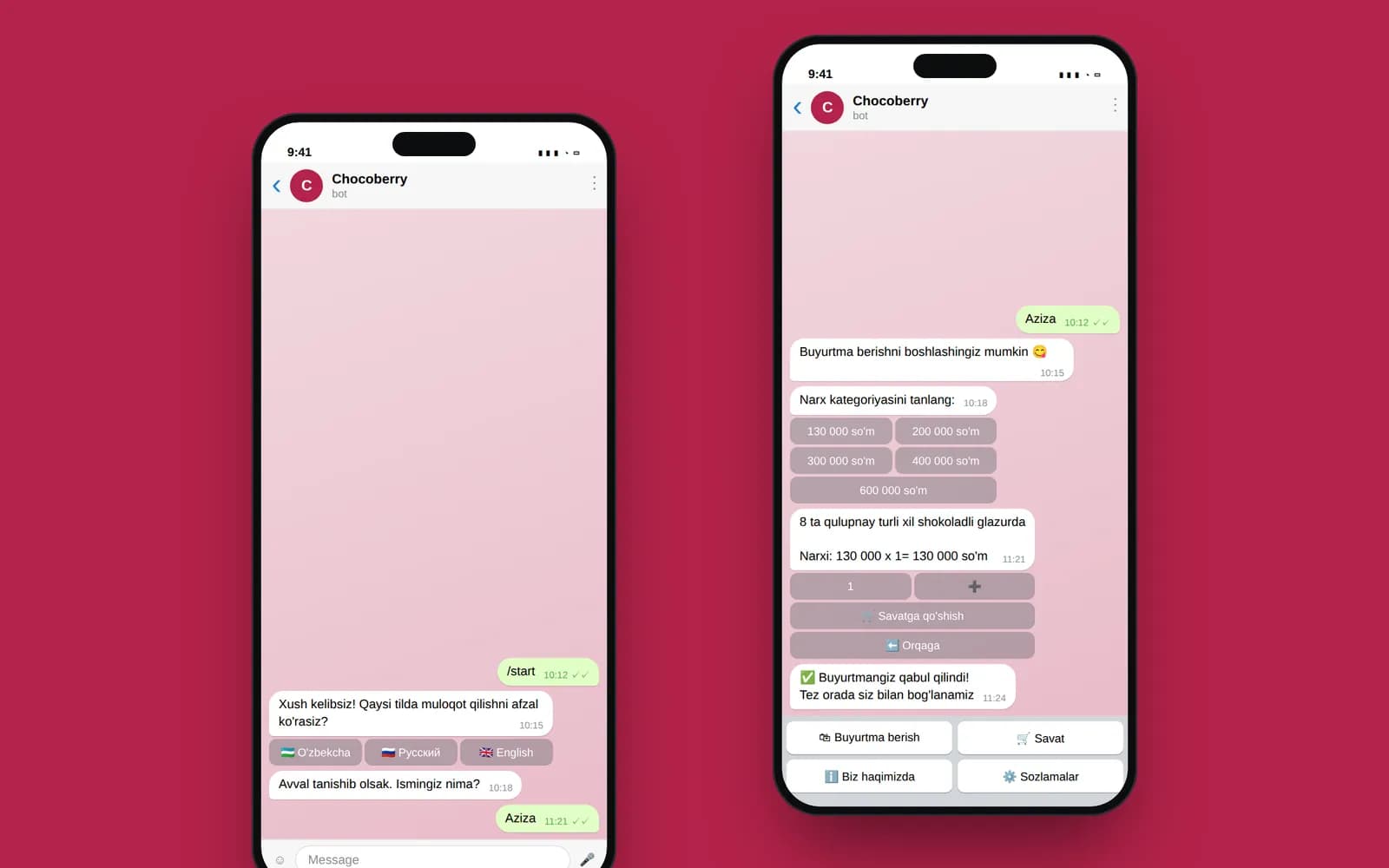
A good example of a button flow is Chocoberry Queen, a bot we built for delivering chocolate-covered strawberries. Here's what ordering looks like (simplified, without the cart and payment):
Every step here is validated. The time slot exists, the date isn't in the past, the map pin is turned into an address through reverse geocoding, and the finished order lands in the operators' channel with a link straight to its card in the admin panel. If an AI sat in this spot, "understanding" that the person wants it "sometime in the evening, somewhere in Yunusabad", I'd have to check each of its decisions with the same code afterwards. Just with an extra step that is sometimes wrong.
| Button bot | LLM bot | |
|---|---|---|
| Orders, bookings, payments | Excellent | Risky |
| Answering common questions | Fine up to 30–40 questions | Fine at any number |
| Questions nobody anticipated | Can't handle them | Its real strength |
| Predictability | Complete | Needs guarding against made-up answers |
| Running cost | Close to zero | You pay for every conversation |
| Uzbek and Russian mixed together | Doesn't matter, people tap buttons | Copes, but weaker in Uzbek |
Where AI genuinely pays off
There are three cases where I suggest an LLM to a client myself.
A large knowledge base
When a company has hundreds of pages of documentation, terms and tariffs, and customer questions don't fit into a menu. A training centre with a dozen courses, each with its own instalment terms. A logistics company with rules on parcel dimensions. Here a button menu turns into a maze, and people end up messaging a manager anyway.
First-line support at night
When questions come in around the clock and operators work nine to six. The AI answers simple questions straight away and gathers context for the hard ones, so the operator doesn't have to open the morning with "hello, how can I help".
Parsing free input
Someone writes "I need 3 boxes on 14 February at the office on Amir Temur". The LLM pulls out the structure: quantity, date, address. Ordinary code with validation still runs after that, but the person doesn't have to click through ten steps.
Where it just annoys people
AI annoys people most when their task is simple and the bot starts chatting. Someone wants to book a doctor for Thursday and gets three paragraphs of polite text followed by "Is there anything else I can help you with?".
The second case is more dangerous: topics where a mistake is expensive.
Models make things up. That isn't a bug in one particular version; it's a property of the technology. You can bring the rate down a lot, but not to zero. So the question isn't "will the bot make mistakes" but "what happens if it gets this particular answer wrong".
What it costs
Clients often think an AI bot is a one-off build. In reality, a monthly API bill appears, and it grows with the number of conversations.
I did a rough estimate on typical assumptions: a conversation of 6 customer messages, a system prompt with a knowledge base of around 3,000 tokens, and bot replies of about 200 tokens. Model prices change every few months, so treat this as an order of magnitude for summer 2026, not a price list.
On their own these aren't scary amounts. But there are two catches. First, someone will inevitably start playing with the bot for fun, and 1,000 conversations become 10,000. You need per-user limits. Second, paying for an API from Uzbekistan is still not the simplest thing; you often need a foreign card. Discuss this before development, not after.
For comparison: the bot itself costs from $300 with us, and after that it costs almost nothing to run apart from the server.
Hybrid: how we do it now
In practice, what works best isn't choosing between buttons and AI but combining them. Our usual setup looks like this:
- Buttons for everything that brings in money. Orders, bookings, payment through Click or Payme, choosing a branch. No neural network here, only steps you can validate.
- An LLM for free text. If someone types instead of tapping a button, the message goes to the model together with the FAQ base. The model answers only from that base.
- An honest "I don't know". If the answer isn't in the base, the model doesn't invent one; it says so. This goes into the prompt and gets checked against test questions before launch.
- Handoff to an operator. A "Talk to a person" button is always there. The question, together with the conversation history, lands in the operators' group, and the bot forwards the operator's reply to the customer.
- A log of questions. Every question the bot answered with "I don't know" is saved. Once a week someone goes through them and adds answers to the base or new buttons.
People underrate the fifth step. After a month, that log tells you more about the business than any analytics: you can see what customers actually ask and what's missing from the website.
Here's what the hybrid looks like to a customer (an illustrative example):
That second reply is, to my mind, the most important part of the whole setup. A bot that admits it doesn't know is far less irritating than one that is confidently wrong.
How to decide whether you need AI
I ask the client three questions. How many different questions do your customers ask: ten or two hundred? What happens if the bot gets an answer wrong? Who is going to read the question log once a week?
If there are few questions, buttons are better. If a mistake is dangerous, a person is better. If nobody will read the log, in three months the AI bot will be answering from an outdated base, and you'd be better off without it.
The first step is almost always the same: build a good button bot, watch what people type as free text, and decide about AI based on that data. If you'd like to start there, there's more on Telegram bot development, and you can message us on Telegram at @Azamat_yamin.