Telegram bot or website: which should you build first?
I get this question on Telegram almost every week, usually from owners of small shops, delivery services and training centres. The short answer: it depends on where your customers come from. The long answer is below, with the table I use on the first call.
 Azamat AbduyaminovFounder, lead engineer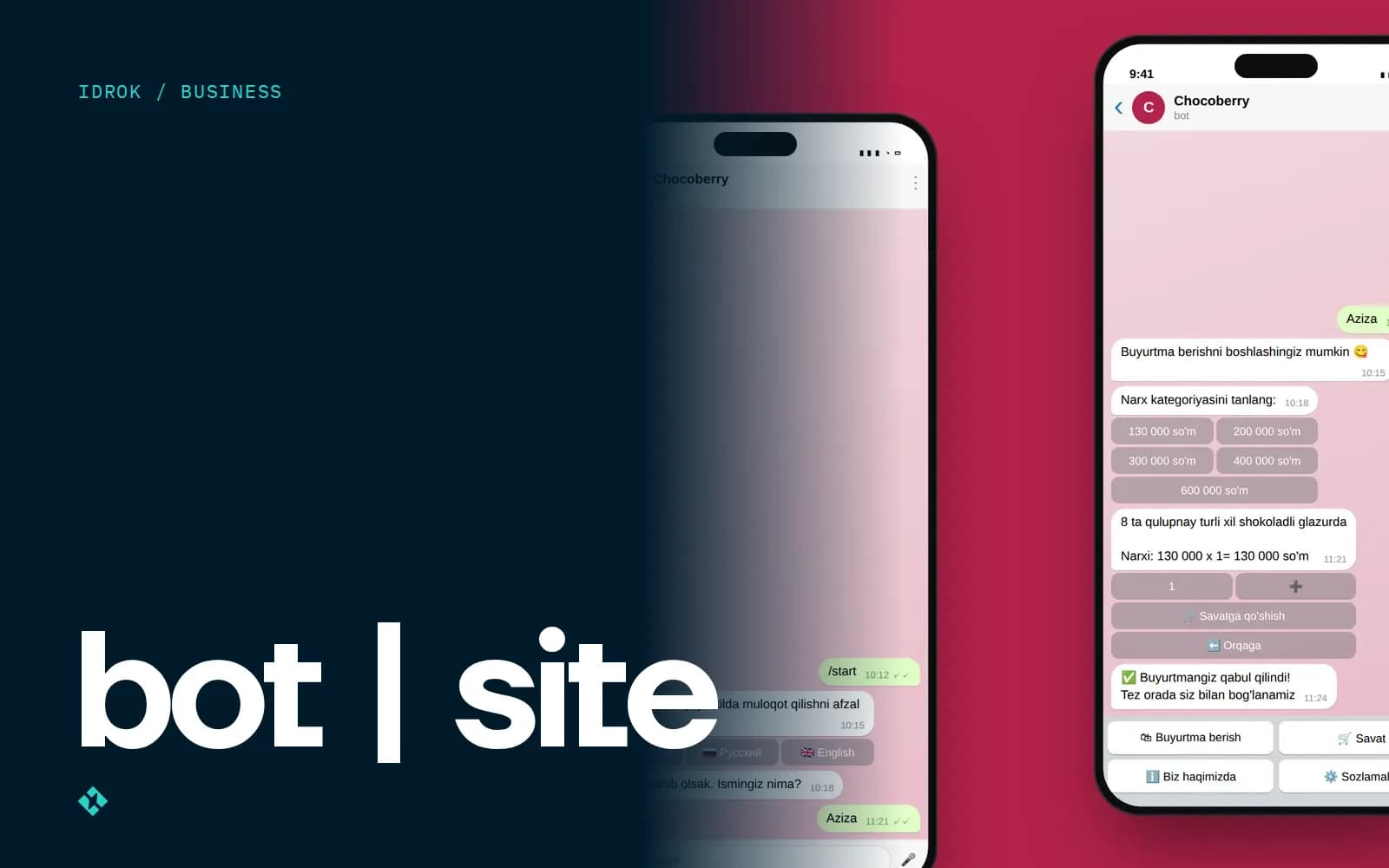
A typical conversation goes like this. “Hi, we do gift delivery, we have Instagram and a Telegram channel, we take orders in DMs. We want a website. Or is a bot better? How much is it?”
I usually answer with a question: “Where do your customers message you now, and what do they ask most often?” If the answer is “in Telegram DMs, they ask the price and how to order,” the first thing to build is almost always a bot. If it's “they find us on Google and then call to check whether we're a real company,” it's a website.
Here's why, using two of our projects.
Where your customer actually lives
In Uzbekistan Telegram isn't just a messenger. It's news, shops, government services, school chats and work email all at once. Tapping a button in a bot is easier for people than opening a browser, finding a site and filling in a form.
But there are two things Telegram does badly.
The first is search. Google and Yandex don't index bots. If someone types “chocolate strawberries delivery Tashkent” or “ship a car from the US,” they won't find your bot. They'll find a website, yours or a competitor's.
The second is trust. When big money, legal services, or a company the person has never heard of is involved, they go and check. A site with an address, a team, case studies and a proper domain is more convincing than a bot with a one-line description.
Chocoberry Queen: when a bot covers everything
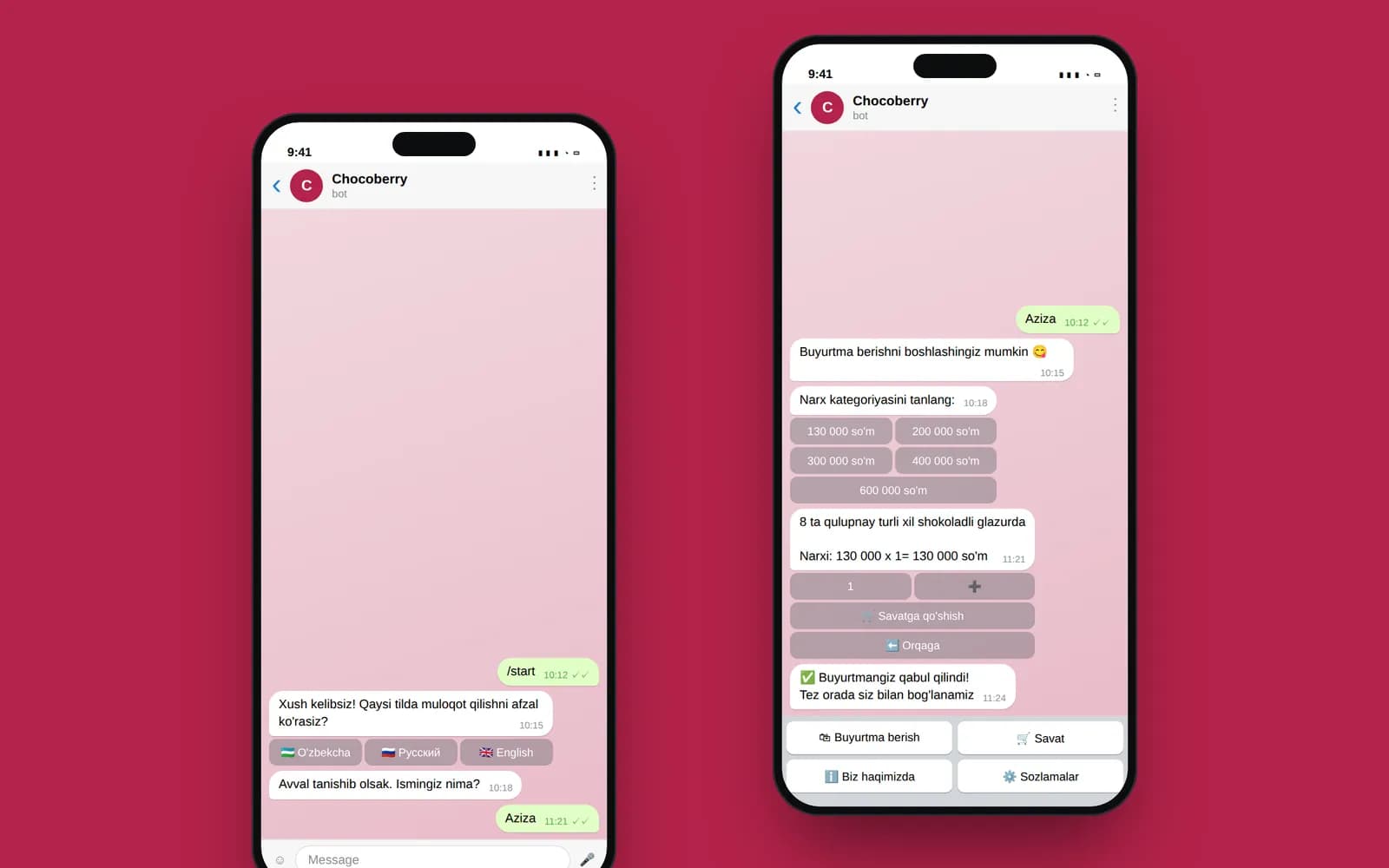
Chocoberry Queen delivers chocolate-covered strawberries as gifts. Customers come from Instagram and Telegram, see beautiful photos and want to order right now, often for today or tomorrow. They don't need site search or an “About us” page. They need to pick a set quickly, say who it's for and where to take it, and choose a time.
We built a bot with a catalogue grouped by price tier, a cart, and a choice of delivery date and time slot. Since it's a gift, the bot asks for the recipient's phone number separately, not just the buyer's. The customer drops a pin on the map, and the bot turns the coordinates into an address with reverse geocoding so the courier doesn't have to work it out.
The order goes to an operators' channel with a button that opens it in the admin panel. The bot works in three languages: Uzbek, Russian and English. The owner edits the catalogue, prices and time slots in the Django admin.
Does a business like this need a website? Eventually, yes: for searches like “gift delivery Tashkent” and for corporate holiday orders. But the bot came first, and that was the right call.
IBN Express: when there's no way around a website
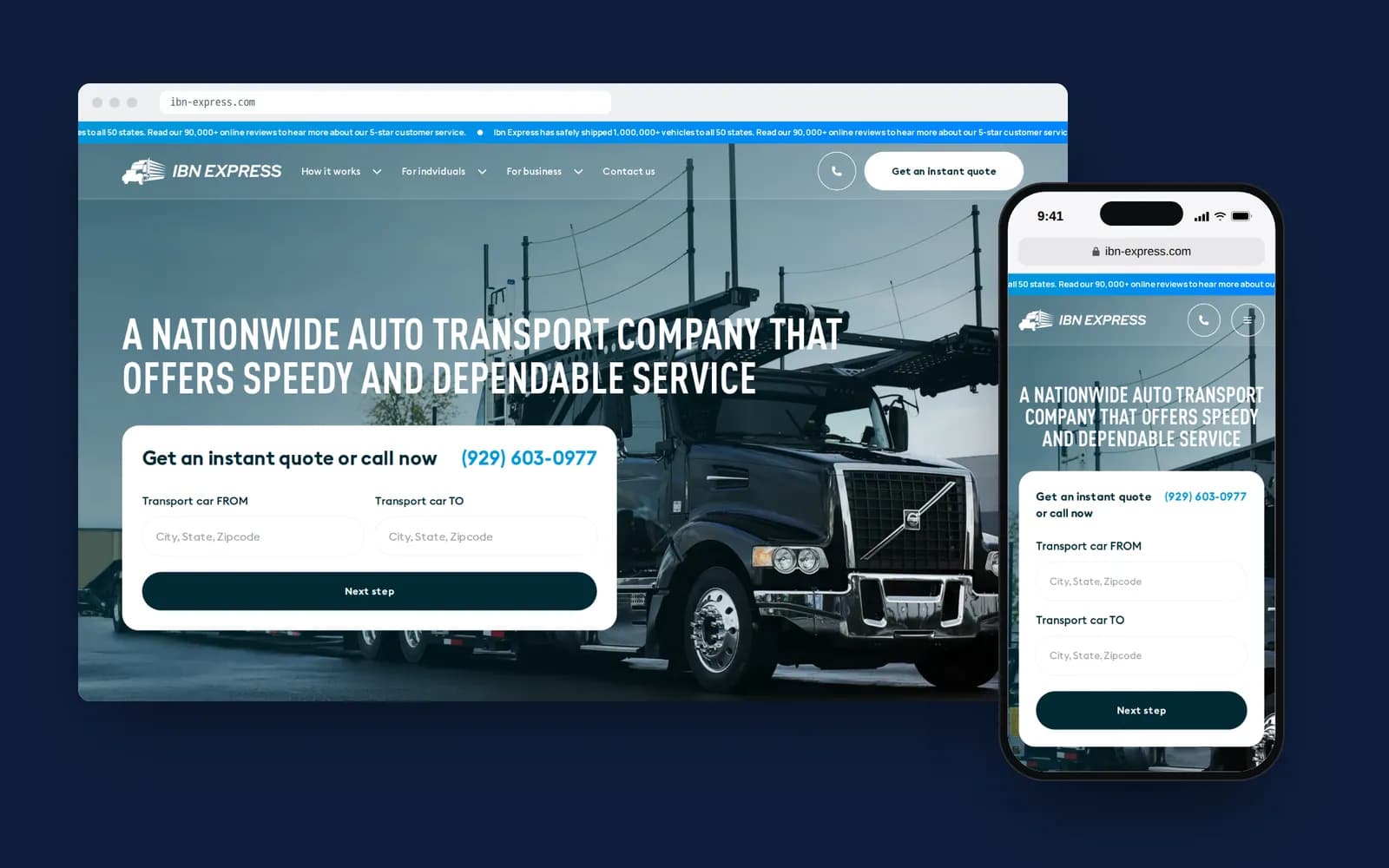
The opposite case. IBN Express ships cars across the US. Its customers google “car shipping quote,” compare companies and check each one. An American customer either doesn't have Telegram or doesn't use it for this kind of thing.
Here the website came first: service pages, a blog, FAQ, reviews, and above all an instant quote. The visitor enters the pickup and delivery ZIP codes (with autocomplete for US ZIPs) and gets a price right away. The lead is saved to the database and instantly pushed to the sales team's Telegram channel.
Note that Telegram is still there, just not for the customer. It's for the team. Salespeople prefer getting leads where they already spend their whole day.
The table I use on the first call
It's not a formula, it's a set of questions. The more answers in the left column, the sooner you need a bot. The more in the right, the sooner you need a site.
| Question | Leans bot | Leans website |
|---|---|---|
| Where do customers come from? | Instagram, Telegram, word of mouth | Google, Yandex, search ads |
| Does the customer know you before first contact? | Yes, already a follower | No, first time seeing you |
| Order value | Up to ~$50, repeat purchases | Large, one-off, long decision |
| What does the customer need? | Order, book, pay | Research, compare, verify |
| How many products or services? | Up to a couple of hundred items | Large catalogue with filters and descriptions |
| Audience | Uzbekistan, everyone has Telegram | Abroad or B2B |
| Do you need Google Ads? | No | Yes, and ads need a landing page |
If your answers split evenly, that's normal. Then I look at the budget and at who will run each channel.
What it costs and what to launch in which order
Our Telegram bots start at $300, while website development starts at $800 for a landing page and $2,000 for a corporate site. An ordering bot with a catalogue, cart and admin panel usually costs more than the minimum, but still less than a good website.
This is how it often grows for the small businesses we work with. The timing is approximate; it's a typical picture, not a promise:
- Month 1A bot for orders or bookings. Leads from Instagram and the channel stop getting lost in DMs
- Months 2–3The owner sees which products sell best and starts asking about ads
- Months 3–4A landing page or simple site for search and ads, with a button that leads into the same bot
- Month 6 onwardsSEO, a blog, reviews. The site catches people who are searching; the bot serves those ready to buy
The key is that the second channel shouldn't duplicate the first but feed into it. The “Order” button on the site opens the bot with a parameter that shows the person came from the site. The catalogue and prices live in one database, so the owner doesn't update them in two places.
My default answer
If you sell in Uzbekistan, your customers are already on Telegram and you're losing orders in DMs, start with a bot. It pays off faster, and you'll quickly learn what people actually buy.
If people find you through search, your product is expensive or complex, or your customers are abroad, start with a website. Keep Telegram for the team: leads to a channel, notifications, internal bots.
A separate word about Instagram, since that's where many of our clients' customers come from. The profile bio has one link, and people often point it at the website “to look serious.” If the site can't take an order in a minute, the Instagram visitor gets lost there. For shops and delivery, put the bot in the bio and let the website handle search. For lawyers, clinics and B2B it's the reverse: someone coming from Instagram wants to check who you are, and a site with a team page and case studies helps with that.
And don't try to turn a bot into a website or a website into a bot. Nobody reads a bot with twenty sections of long text. A site whose only action is “Message us” loses the people who want to buy right now.
You can see how this works in practice in the Chocoberry Queen and IBN Express case studies. If you're unsure about your own case, message me on Telegram at @Azamat_yamin and we'll go through the table above together.