Yandex Direct in Uzbekistan: who still needs it in 2026
Half of our clients ask why they would need Yandex when “everyone is on Google”. The other half are sure they can't do without it. Both are partly right, and it all comes down to which language your buyer searches in.
 Mirodil OrtiqovBackend developer
My day job is backend: Django, FastAPI, bots. But somehow I'm the one at the studio who usually sets up analytics and the "site → Metrica → Direct" chain. Probably because I complain the loudest when Metrica goals fire on the wrong thing.
The Yandex question comes up on Telegram in almost every conversation about ads. Here is my honest answer, without trying to sell you one more ad channel.
Who in Uzbekistan searches on Yandex
Google dominates in Uzbekistan. According to public trackers like StatCounter, Yandex holds roughly a tenth of the search market, sometimes a bit more. Different services disagree, so treat that as an order of magnitude, not an exact figure.
But that tenth isn't uniform. In our observation Yandex has a disproportionate share of:
- Russian-speaking users in Tashkent, especially those over 35;
- people with Yandex as the browser or start page on their work computer;
- office staff searching for contractors and services for their company;
- people who got used to Yandex while studying or working in Russia.
An Uzbek-speaking user on a phone searches on Google almost every time. If your customer types "uy ta’mirlash narxi" (home renovation price), Yandex won't give you much.
Who Direct works for
- +Your audience speaks Russian, and you see it in your chats and leads
- +B2B: lawyers, accounting, equipment, packaging, logistics
- +An expensive service where one lead pays for a month of ads
- +Tashkent and the surrounding region rather than other provinces
- +The Google auction for your queries is already overheated
- −Your audience writes in Uzbek, especially outside Tashkent
- −Less than $150 a month for clicks: not enough even for one channel
- −No website, only Instagram and Telegram
- −A cheap impulse product where the decision takes a minute
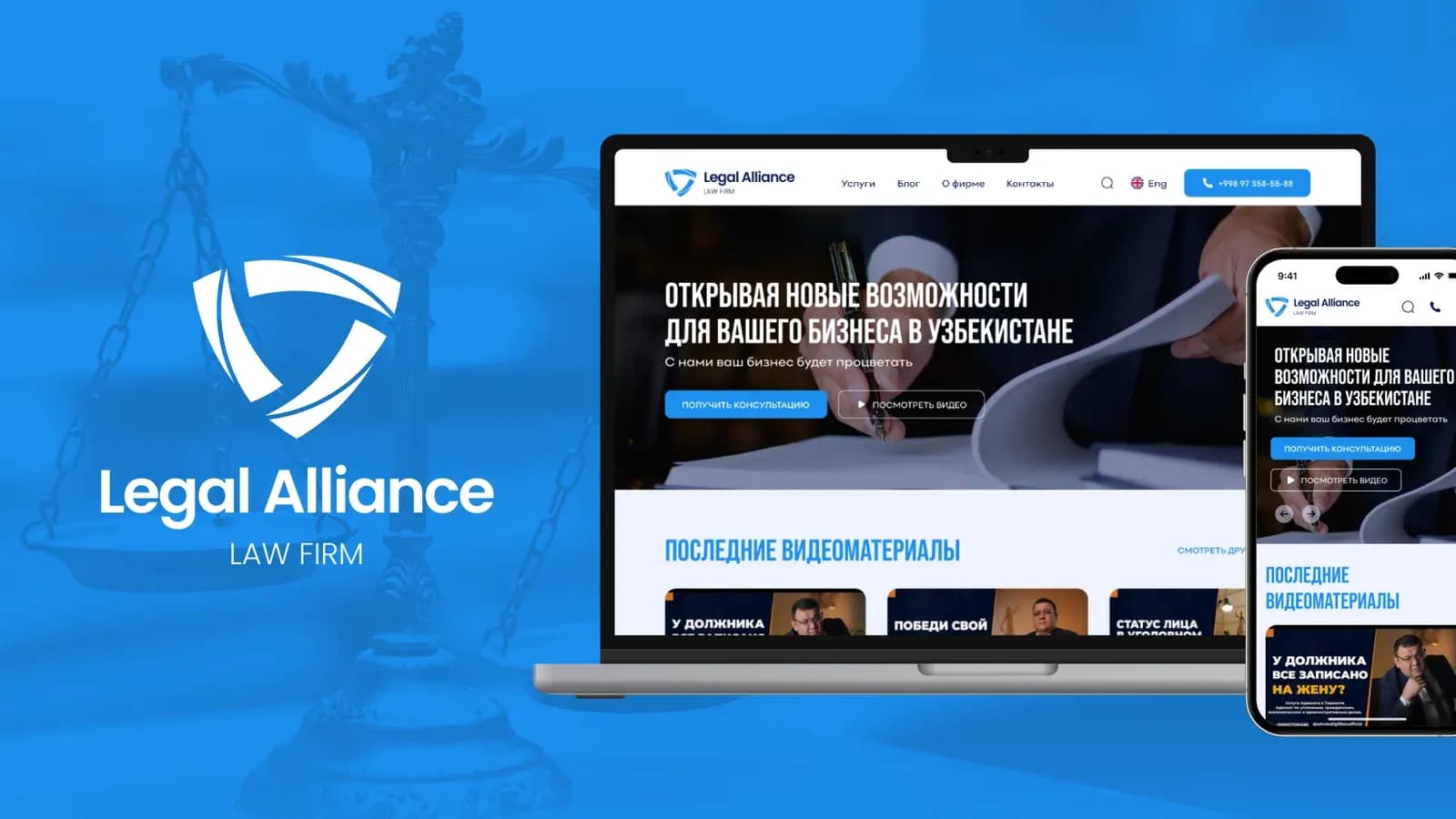
A good example from our work, though not an ads one: law firm websites. The Legal Alliance site has Russian and Uzbek versions, and for a law firm with twenty years of practice a Russian-speaking client in Tashkent is entirely typical. For a business like that I would at least test Yandex. For a henna salon in Chilanzar whose clients write in Uzbek, probably not.
Campaign Master or manual setup
Direct currently has two main routes. Campaign Master (Мастер кампаний) is the simplified mode: you give it the site, a goal and a budget, upload copy and images, and the algorithm decides the rest. The manual route is the Unified Performance Campaign (ЕПК), which Yandex moved the classic text-and-image campaigns into. There you can separate search from the network, set keyword phrases, negative keywords and placement bids.
| Campaign Master | ЕПК (manual) | |
|---|---|---|
| Time to launch | An hour or two | A day or more |
| Control over queries | Minimal | Full: phrases, negatives, search query report |
| Needs conversion history | Preferably, or it learns slowly | Can start on pay-per-click |
| Risk of junk traffic from the ad network | Higher | Network can be switched off entirely |
| Good for | Quick demand tests, shops | Services, B2B, narrow niches |
We nearly always start with ЕПК on search only. The Yandex Advertising Network (РСЯ) works well in Russia, where there are plenty of placements. With Uzbekistan as the geo there are fewer good ones, and the budget easily drains into apps and dubious sites. We try Campaign Master once Metrica has accumulated conversions and we want to give the algorithm more freedom.
Metrica: without goals, Direct shoots blind
This is the most important part, and the one most often done sloppily. Direct can optimise for Metrica goals, but only if those goals are set up honestly. If the goal is "viewed two pages", the algorithm brings people who view two pages. Not people who write to you.
The order in which I set up Metrica on a new project:
- Counter with Webvisor. Install the counter on every page, turn on Webvisor and the click map. After a week, session recordings show where people get stuck better than any audit.
- Check auto-goals instead of accepting them. Metrica creates auto-goals such as "Messenger click" and "Phone click" by itself. Handy, but every time I check that they catch the button on the site and not the Telegram channel link in the footer.
- Your own goals via reachGoal. Form submissions and the "Message us on Telegram" button get a JavaScript event:
ym(ID, 'reachGoal', 'lead_submit'). A single function on the site sends the same event to both Metrica and GA4. - A composite goal for what matters. For example "opened the form → submitted the form". That shows where people drop off.
- Attach goals to the Direct campaign. The key goal is the lead, not the messenger click. The messenger click can be added as a second goal with a lower value.
- Reality check. Once a week we compare Metrica goals with what actually arrived in the Telegram leads group. If they differ by more than 2x, we look for what broke.
On our landing pages where leads go to a Telegram group, the form calls one track() function after a successful submit, and it sends the event to GA4, Metrica and Meta Pixel (if connected) at once. That way the numbers in different systems at least count the same event. I wrote more about this kind of tracking in the post on leads that come through Telegram.
When to skip Yandex
Sometimes the most useful advice for a client is not to spend money on Yandex this quarter. I say that when:
- the total ad budget is under $300–400 a month. Splitting it between Google and Yandex gives you two half-trained channels instead of one working one;
- conversions aren't set up in Google yet. First one channel that counts leads, then a second;
- the audience is young and Uzbek-speaking. They need ads on Instagram and Telegram, not on Yandex search;
- there is nobody who will look at the search query report at least once a week.
“We don't sell "Google plus Yandex" as a bundle. First we bring one channel to a clear cost per lead, and only then decide whether a second one is needed.”
A separate issue is paying from Uzbekistan. Terms for advertisers from Uzbekistan have changed more than once in recent years, so before a launch I always check Yandex's current rules and don't promise the client a date until the money has reached the account.
How I would start on a small budget
If you've decided to try, here is a minimal plan that won't hurt to fail:
- One ЕПК campaign, search only, Tashkent only.
- 20–40 Russian keyword phrases for the most specific queries, no broad words like "юрист" (lawyer) or "упаковка" (packaging).
- Negative keywords from the Google campaign, translated and expanded.
- Goal: a lead, or a Telegram button click you have verified by hand.
- One month without drastic changes. Then compare cost per lead side by side with Google.
If after a month a Yandex lead costs twice as much as a Google one, that's not a verdict yet. In B2B it happens that fewer people come from Yandex, but with bigger orders. So we look not only at cost per lead but also at what happened to those leads a month or two later. If there are zero leads and almost no searches, your audience simply doesn't live on Yandex, and that is a result too.
Why Uzbek-speaking and Russian-speaking audiences search so differently, Azamat covered in his post on SEO for a website in Uzbekistan. How we run both ad channels is described on the Google & Yandex ads page.