How to start SEO for a website in Uzbekistan with zero experience
About once a week someone messages me on Telegram with roughly the same line: “We have a website, it brings no clients, please do SEO.” Behind that sentence there is almost never one big mistake. There are five small ones. Here is how I explain SEO to people hearing the word for the first time, and where we start ourselves.
 Azamat AbduyaminovFounder, lead engineer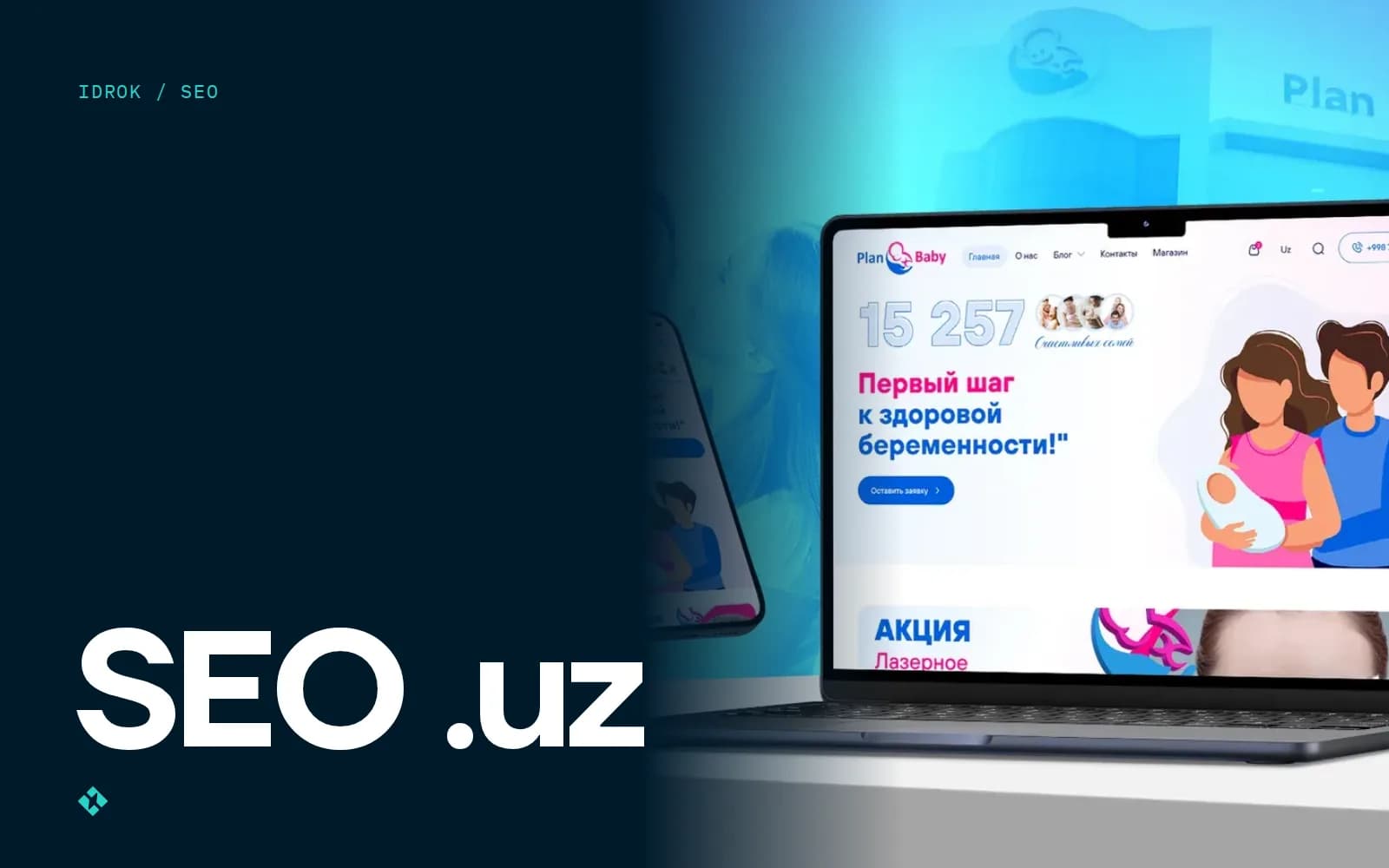
A few years ago our blog had a post called “Why do you need SEO?” I reread it before sitting down to write this one and felt a bit embarrassed. It was correct, polished and completely useless to a travel agency owner in Chilanzar who just wants to know why his site doesn't show up for “tours to Turkey”.
So I'm writing it again. No theory for the sake of theory, just what we actually do in the first months.
First, what SEO is not
SEO is not a button a developer presses before launch. Nor is it “putting keywords in the meta tags”, even though that advice still circulates in business owners' group chats.
If I squeeze it into one sentence: SEO is the work of making your page the best answer to the question a person types into search, and making sure the search engine can tell.
That sentence has three parts, and each is its own job:
- the person's question — you need to know how your customers search, in which language, with which words;
- the best answer — the site needs a page that answers exactly that question, not a homepage with a slider;
- the search engine can tell — the technical part: speed, indexing, markup, page URLs.
Most sites that come to us fail on the first point. Technically things are more or less fine, but the pages are written in the owner's words, not the buyer's.
Google, Yandex and three languages for one query
Uzbekistan is more interesting than most markets here. Two search engines live side by side, and there are effectively three query languages.
Who searches where
Google has the overwhelming share of search here. Public counters like StatCounter have put it above three quarters for a long time. Yandex is much smaller, but it's too early to write it off: the Russian-speaking audience uses it, especially in Tashkent, especially older people and B2B buyers who have had Yandex as their browser homepage since 2010.
| Yandex | ||
|---|---|---|
| Who searches | almost everyone, especially in Uzbek | mostly Russian speakers, Tashkent |
| Tool for site owners | Google Search Console | Yandex Webmaster |
| Analytics | GA4 | Yandex Metrica |
| Maps and reviews | Google Business Profile | Yandex Maps (Business) |
| What matters at the start | structure, content, speed | site region, behavioural signals |
We connect both webmaster tools for every client, even when Yandex seems unnecessary. It takes fifteen minutes and the data comes in handy later.
Latin, Cyrillic, Russian
This is where the local specifics start, the stuff translated guides never mention. The same person might search “homiladorlik kalkulyatori”, “ҳомиладорлик калькулятори” and “калькулятор беременности” (all three mean “pregnancy calculator”). Those are three different queries with different volumes and different competitors.
On top of that, Latin Uzbek itself is spelled inconsistently: o‘ with an apostrophe, with a backtick, or just plain “o”. Google merges the variants reasonably well, but not perfectly.
For most businesses we work with the picture looks like this: Uzbek Latin is growing fastest, Russian is still strong in Tashkent and in B2B, and Cyrillic holds on in certain topics and with older audiences. The practical takeaway: the site needs at least two languages, and each version should be written for its own queries rather than machine-translated.
What PlanBaby and Biz Tour taught us
Two projects from 2023 show nicely where SEO gets built in from the start and where you end up catching up later.
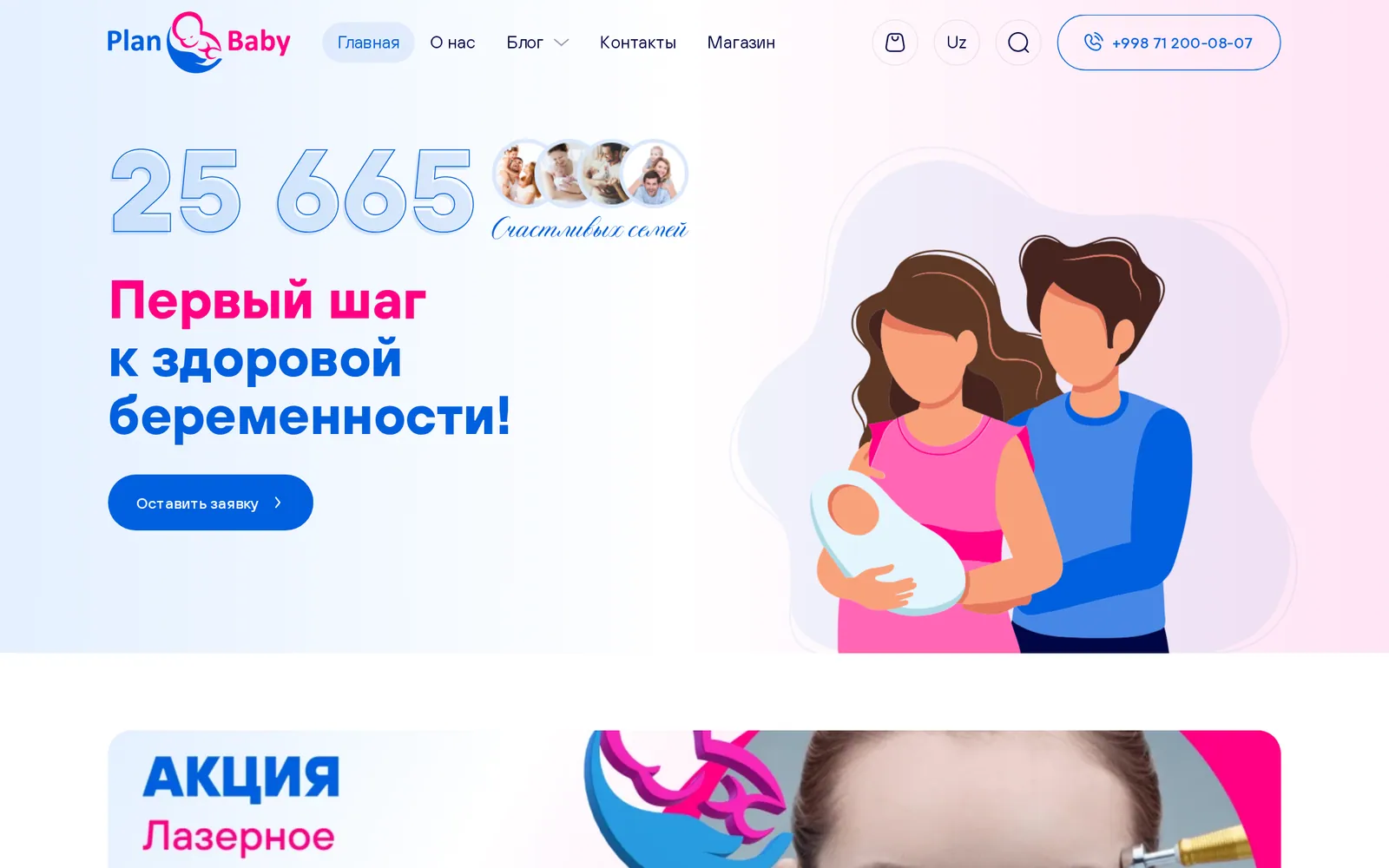
PlanBaby is a pregnancy-planning and parenting platform in Uzbek and Russian. It has articles, stories, a shop and tools: a pregnancy calculator and a baby-name database. The tools turned out to be the project's strongest SEO asset, because people search for exactly those, not for “articles about pregnancy”.
Now, honestly, about a mistake. We built the name database as a single page with search inside it. Convenient for users, nearly useless for Google: an individual name has no URL of its own, so a page like “meaning of the name Amina” can never appear in results. If I were building it today, every name would get its own page with a short text in both languages. Hundreds of small pages for hundreds of specific searches.
Biz Tour is a travel agency with a tour catalogue. The lesson there was different. Travel demand is seasonal, and people don't search for “travel agency”, they search for a destination plus departure city: “Sharm el-Sheikh from Tashkent”, “Istanbulga tur narxi”. A page per destination works better than one general catalogue, even if the tours on it change every month. The page URL has to stay put, though, or everything it earned during the season disappears with the old address.
The first 90 days
When a client comes to us for SEO on a site that is already live, the first three months look roughly like this. The day counts are approximate; the order isn't.
- Week 1Connect Google Search Console, Yandex Webmaster, GA4 and Metrica. See what is already indexed and which queries the site shows up for.
- Week 2Technical audit: sitemap, robots.txt, duplicates, broken links, mobile speed. The most critical things get fixed right away.
- Weeks 3–4Collect queries in all three languages and group them by meaning. Each group gets exactly one page.
- Month 2Rewrite or create the key pages: services, destinations, categories. Headings, copy, internal links.
- Months 2–3Google Business Profile and Yandex Maps listings, if the business has an office or a shop.
- Month 3First articles for informational queries, a look at what has started appearing in Search Console, adjustments.
Notice what's missing: buying links, fake traffic, “directory submissions”. In 2025 that is a waste of money at best and a reason for penalties at worst.
A separate word on speed. A lot of our sites get opened over mobile internet somewhere in Kashkadarya, and a site that takes six seconds to load loses before the search engine has evaluated anything. More on that in the post about how a slow site costs you money.
What it costs and when to expect results
The least pleasant conversation, so let's go straight to numbers.
Our SEO retainer starts at $300 a month. Not a fortune, but not instant results either. The first movement in Search Console usually shows up after 6–10 weeks: the site starts appearing for new queries, even if on page two or three. A noticeable flow of clients in moderately competitive niches tends to come after around 4–6 months.
It can be faster if the niche is narrow and there are hardly any competitors writing in Uzbek. That happens to us more often than you'd think: in plenty of topics there is still simply nothing to show in Uzbek Latin, and a decent page reaches the top in a couple of weeks.
It can be slower too. If you sell loans or apartments in Tashkent, get ready for a long game, and it's wiser to run search ads alongside from the start.
I'm still not convinced everyone needs SEO. If you have one product, customers come by word of mouth and from Instagram, and the site exists mainly to build trust, then a clean technical base plus a maps listing may be enough. Paying for SEO every month makes sense when there's search demand out there that you aren't capturing yet.
What you can do tomorrow without hiring anyone
If you've read this far and want to start on your own, here is the minimum that needs neither money nor a developer:
- Connect Google Search Console and Yandex Webmaster. If the site was built by us or any other decent studio, a sitemap already exists and you just need to submit it.
- Open the “Performance” report in Search Console. Which queries already bring impressions? There are often surprises there.
- Write down the 10 questions customers ask you most often on Telegram. Each of them deserves a page, or at least a section, on the site.
- Check whether the site has an Uzbek version and whether it's written in natural language rather than run through a translator.
If any of this is unclear, or Search Console shows something strange, message me on Telegram at @Azamat_yamin and I'll take a look.