Local SEO in Tashkent: Google, Yandex Maps and 2GIS
For a beauty salon or a clinic, the map listing often matters more than the website. Someone searches for “manicure near me”, sees three pins on the map and picks the one with decent photos and clear directions. I'm a designer, so this post is mostly about how a listing looks, not just how to fill it in.
 Murodjon MaxmudovDesigner
The first time I opened one studio's listing on Yandex Maps, it had exactly one photo. The building's facade, shot from a car, with a red circle drawn around the sign and other people's licence plates in the foreground. Meanwhile the studio does beautiful work and has tens of thousands of Instagram followers. Nobody had ever thought of the listing as a shop window.
That's a typical Tashkent story. A business invests in Instagram, sometimes in a website, while the maps get filled in by some employee in five minutes on day one and never touched again.
Why the map matters more than you think
For an offline business the customer journey is often short. Someone in Tashkent searches “henna salon” or “IVF clinic Samarkand”, and Google first shows a map block with three listings, and only then the regular websites. Yandex does the same for Russian-language searches. Many people never make it to the website: they call, message or build a route straight from the listing.
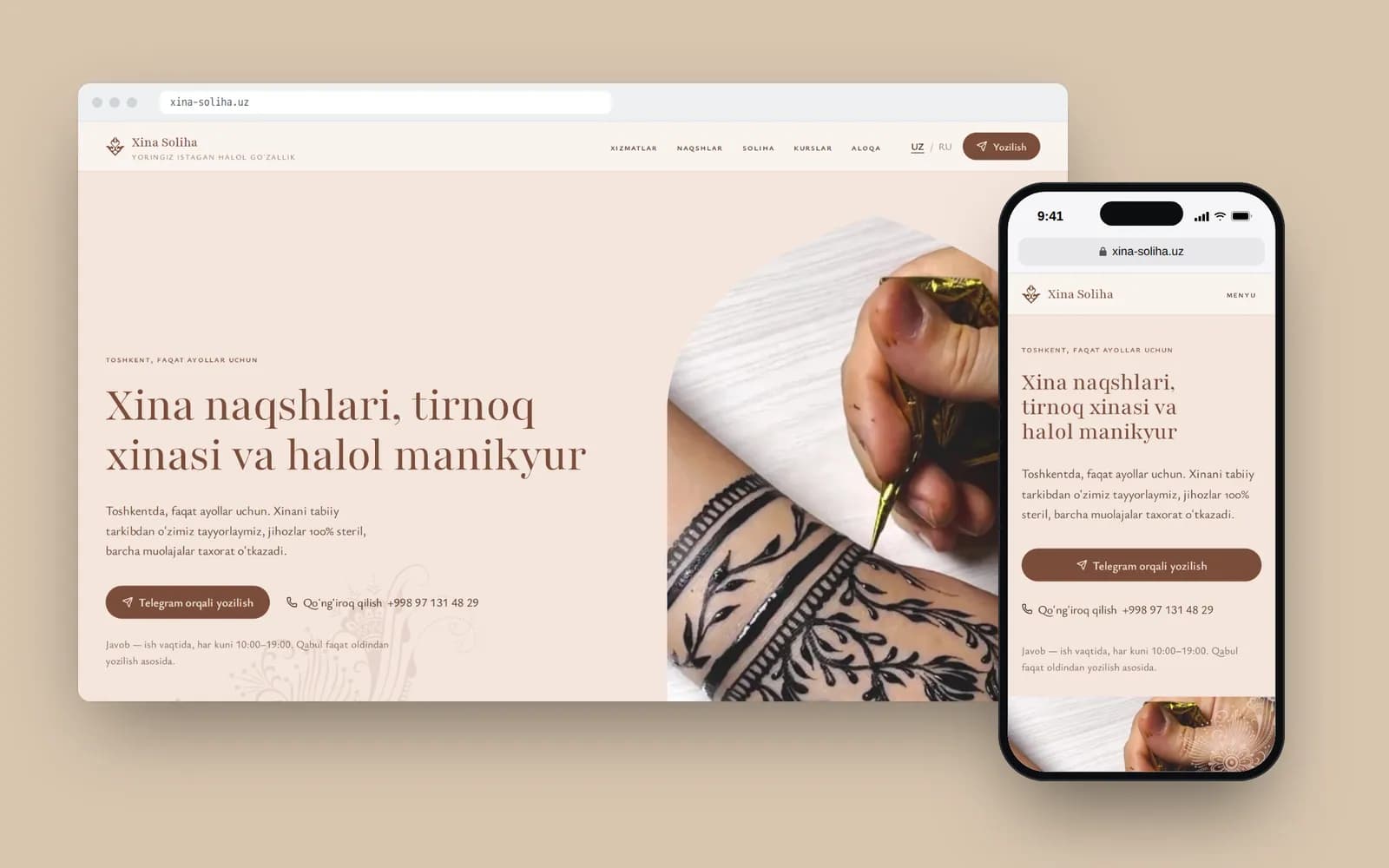
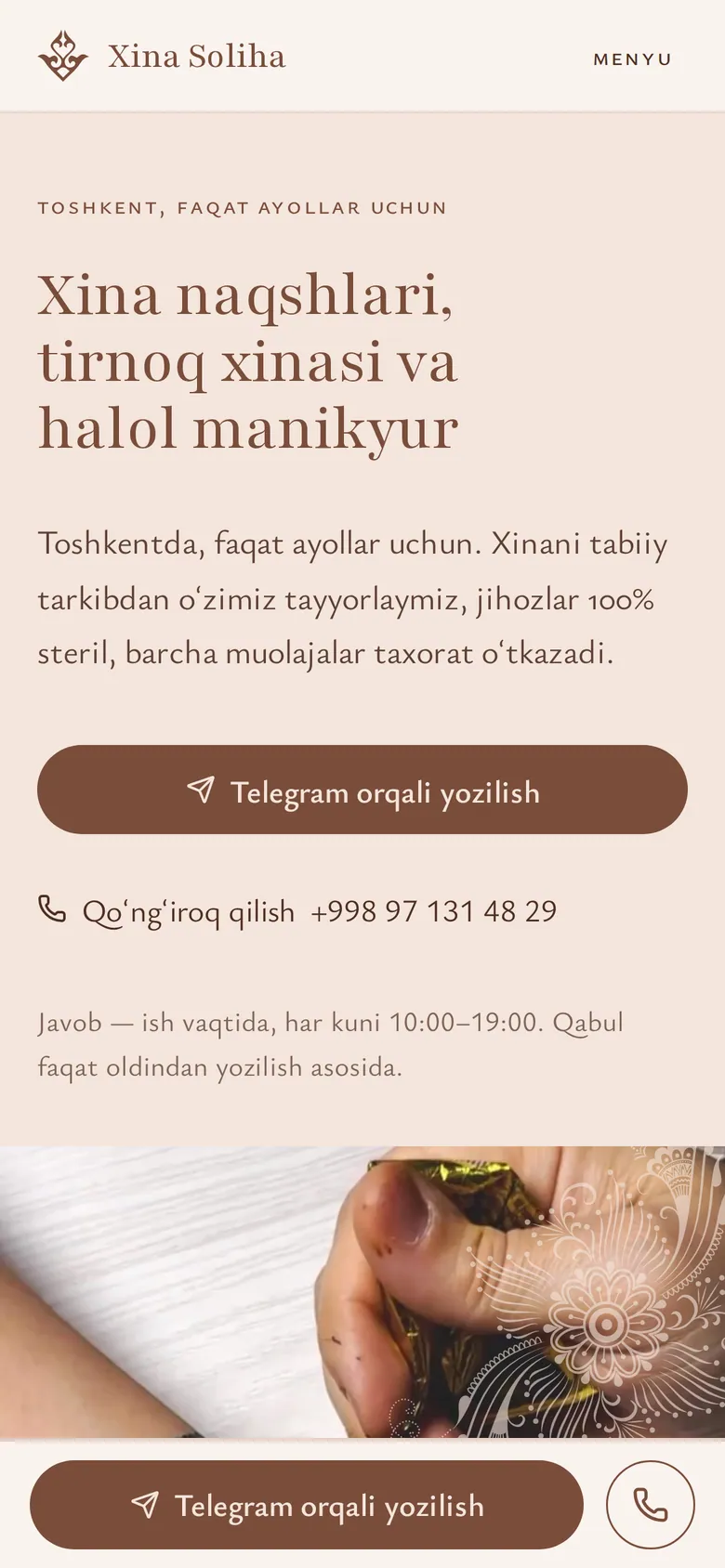
We work with two very different businesses that show this well. Xina Soliha is a women-only halal henna and mehendi studio with its own academy. İstanbul EKU Markazi is a network of IVF clinics in Tashkent, Samarkand and Urgench. For the first, the map answers “how do I find the studio”; for the second, it's also a question of trust.
Which map is for whom
The short answer: fill in all three. The long answer is in the table, based on our experience in Tashkent.
| Google Business Profile | Yandex Maps | 2GIS | |
|---|---|---|---|
| Where it shows | Google Search, Google Maps | Yandex Search, Yandex Maps, Navigator, Go | the 2GIS app |
| Who looks | everyone, especially Uzbek-language search | Russian speakers, drivers, taxis | people looking for the entrance, floor, hours |
| Strength | reviews and “near me” results | routes and address accuracy | building and entrance details |
| Verification | by video or code | via the Yandex Business dashboard | via the 2GIS dashboard |
Yandex Maps is stronger in Tashkent than Yandex's share of search would suggest. Lots of people build routes in Yandex Navigator and order taxis through Yandex Go, and the address there is pulled straight from the listing. If the listing is wrong, the driver takes your client to the wrong place.
One name, one address, one landmark
In SEO this is called NAP: name, address, phone. Your business details must match everywhere: on the website, on all three maps, on Instagram, in your Telegram channel. Sounds simple, but we have our own local twist.
A business name can live in three spellings: Latin, Cyrillic and Russian. So can the street: “Qoratosh ko‘chasi” and “улица Караташ” are the same address but two different strings to a search engine. We pick one main spelling per language and then use it everywhere with no variations.
And then there's the landmark. In Tashkent people navigate not by house number but by “mo‘ljal”, a landmark: next to Korzinka, across from the metro, second floor above another salon. Xina Soliha is in fact on the second floor of a building where another beauty salon operates. Without the landmark and floor in the description, clients would be calling to ask where the entrance is. We put the landmark into the listing description, next to the address on the website, and into the markup.
- Name, address and opening hours match on the website and on every map
- One spelling of the name and street is chosen for each language
- The description includes a landmark, the floor and how to find the entrance
- The map pin is placed on the entrance, not the middle of the building
- The website has LocalBusiness markup (or a more specific type) with coordinates
- The website links to the listings, and the listings link to the website and Telegram
- Each branch has its own listing, its own page on the site and its own address
That last point matters for chains. One “İstanbul EKU” listing for three cities doesn't work: someone in Urgench needs to see the Urgench branch with its own hours and address.
Photos: what to post and what to avoid
This is my part of the job, and it's where I see the most mistakes.
Listings are ranked partly on activity and completeness, and photos are the most visible completeness signal. But something else matters more: people choose between three listings with their eyes. I always put together a small set for a listing:
- a logo cropped for both square and circle, with no fine print that turns into a smudge at 48 pixels;
- a cover image, horizontal, showing the space rather than one person in close-up;
- the facade or entrance in daylight, without cars with visible plates or other businesses' signs if possible;
- the interior in 3–5 shots, with decent light;
- work or process shots, and for a clinic, equipment and rooms.
And don't use stock photos. Yandex and Google sometimes detect them on their own, but the bigger problem is that the client shows up and sees a different room. That's worse than having no photos.
Reviews and booking through Telegram
We have one rule for reviews: don't buy them and don't write them yourself. No map forgives that, and customers have long since learned to spot five identical reviews posted on the same day.
What works is asking. After a visit, the administrator sends a short Telegram message with a link to a listing. Not all three at once, just one, or the person won't leave any. We usually alternate: Google this week, Yandex the next.
And reply to every review, including the bad ones. Calmly, without the “Thank you for your feedback, it is very important to us” template. People who read reviews before booking look at the owner's replies at least as closely as at the stars.
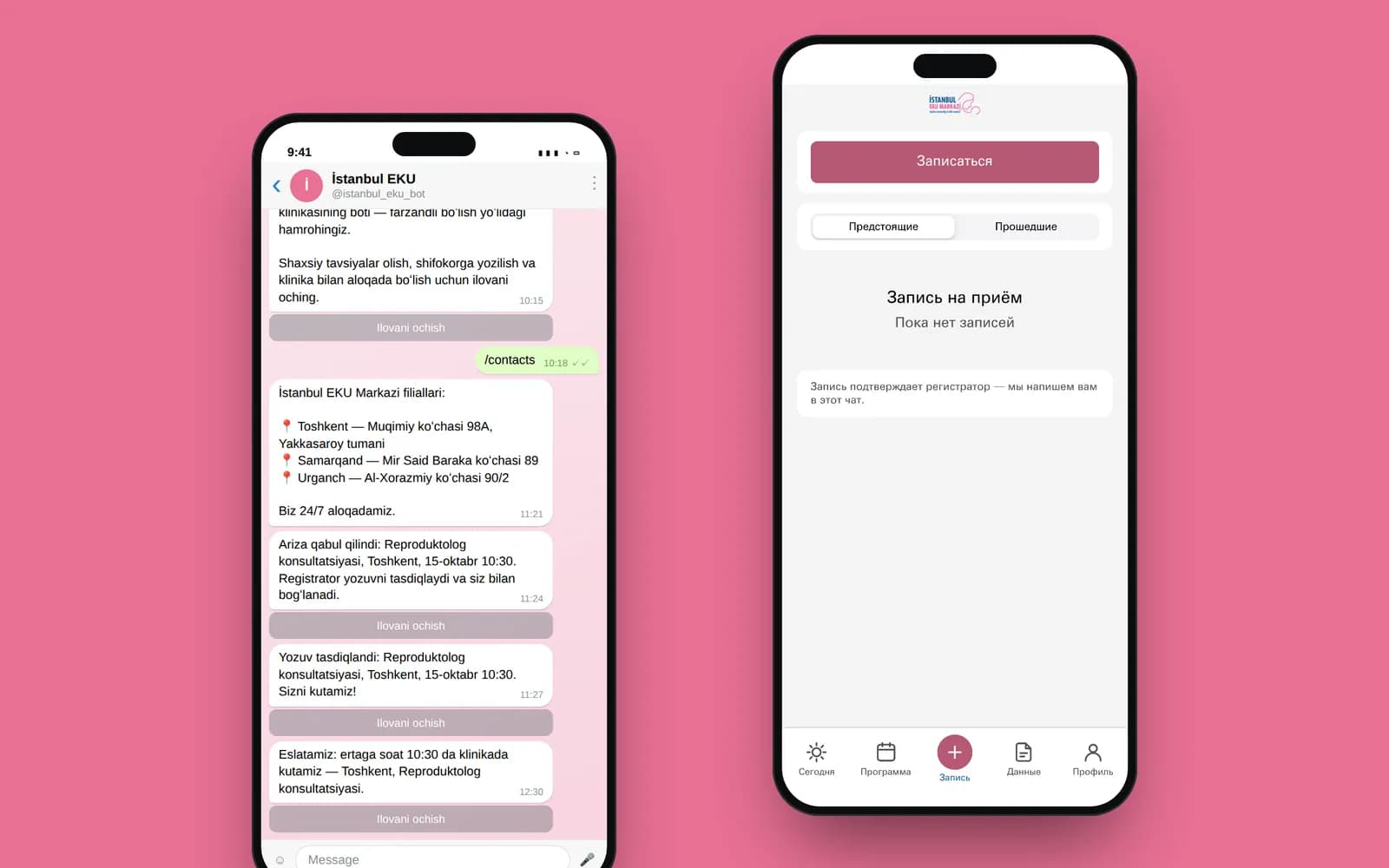
About bookings. In Uzbekistan the “Call” button on a listing works worse than you'd expect: many people would rather message. So we put a Telegram booking link into the listing. For Xina Soliha that's a chat with the administrator; for İstanbul EKU it's a bot where you choose a branch and a service. A booking in the bot starts roughly like this:
A separate link in each listing also lets you count how many bookings came specifically from the maps. Azamat wrote about tying the website and bot together in his post on what to build first, a bot or a website.
Where to start this week
If you've done nothing with maps so far, here's the order I'd suggest:
- Find your business on all three maps. Listings have often already been created by someone, sometimes with mistakes. Claim them.
- Write down one name, an address with a landmark, and your hours. Copy them everywhere, identically.
- Take 10–15 decent photos in daylight. A phone is fine as long as the light is good. It's half a day of work, not a photo shoot.
- Add a Telegram booking link to the listings.
- Start asking for reviews, one channel at a time.
You still need a website: the listings point to it, and it answers the questions a listing has no room for. We covered the technical side of sites for businesses like these in our technical audit checklist. But if an offline business in Tashkent asks me where to start, I'd start with the maps.